Sarah, 49, had read every trigger list going. Avoid alcohol, avoid caffeine, avoid spice, avoid hot drinks, avoid stress: which, taken together, is less a strategy than a description of not having a life. So she tried something more useful. For two weeks she kept a diary, noting every flush and everything she'd eaten, drunk and felt in the hours before it. Sarah is a fictionalised composite of readers who've shared their diaries with us, and her fortnight is exactly that: one reader's experiment, n=1, not a trial. That's precisely why it's worth reading.
What she tracked
Nothing clever. A notes app, and for each flush: the time, a severity score out of five, and what the previous few hours had held across five columns: alcohol, caffeine, spicy food, hot drinks and stress, plus a morning note of how she'd slept. Thirty seconds per entry, no wearables, no spreadsheet formulas.
What the evidence says about her suspects
Before her results, the state of the science, honestly told. The physiology underneath is reasonably well described: falling oestrogen appears to narrow the brain's thermoneutral zone, the band of core temperature it tolerates before triggering an emergency cool-down. Triggers matter because they nudge you toward that narrowed threshold.
- Alcohol has decent observational support as a trigger: it dilates blood vessels and disrupts sleep, and studies link intake with flush frequency, though findings aren't fully consistent.
- Caffeine also has observational backing; a Mayo Clinic survey study linked it with more bothersome flushes in menopausal women, though again not every study agrees.
- Spicy food varies wildly by person. Capsaicin genuinely activates heat receptors, but plenty of women eat fiery food with no effect whatsoever.
- Hot drinks are mostly about physics: they raise core temperature slightly, which matters more when your tolerance band is narrow. An iced version of the same drink often solves it.
Her surprise results
Two things upended Sarah's assumptions. First, wine was a far bigger trigger than coffee. She'd been rationing her beloved morning flat white for a year, yet her diary showed no pattern around caffeine at all; meanwhile two glasses of wine predicted a bad evening and a worse night with grim reliability. Second, her fiercest flushes didn't follow spice, which she'd confidently blamed. They followed poor sleep. A short night was the single strongest predictor of a flushy day, with stress close behind; the curry was innocent all along.
"A fortnight of honest notes taught me more than every trigger list I'd ever been handed. My triggers, it turns out, are mine."
Why n=1 beats the generic list
The research on triggers is mostly observational and describes averages across thousands of women. You are not an average; you are one woman with one pattern. A generic list had Sarah avoiding things that never bothered her while missing the sleep connection entirely. Two weeks of data traded vague dread for two specific, actionable findings. If you try it, track for the full fortnight before drawing conclusions, and expect mess: hormones fluctuate week to week, so patterns only emerge with repetition.
The template
For each flush, one line:
- Time and severity (1 to 5)
- Previous 3 hours: alcohol (units), caffeine (drinks), spicy food (yes/no), hot drinks (yes/no)
- Stress right now (1 to 5)
- Each morning: hours slept and how broken the night was
After fourteen days, look for what repeats. One clear pattern is a result; no pattern at all is also a result, and a liberating one, because it means you can stop white-knuckling the trigger lists.
Where to start tonight
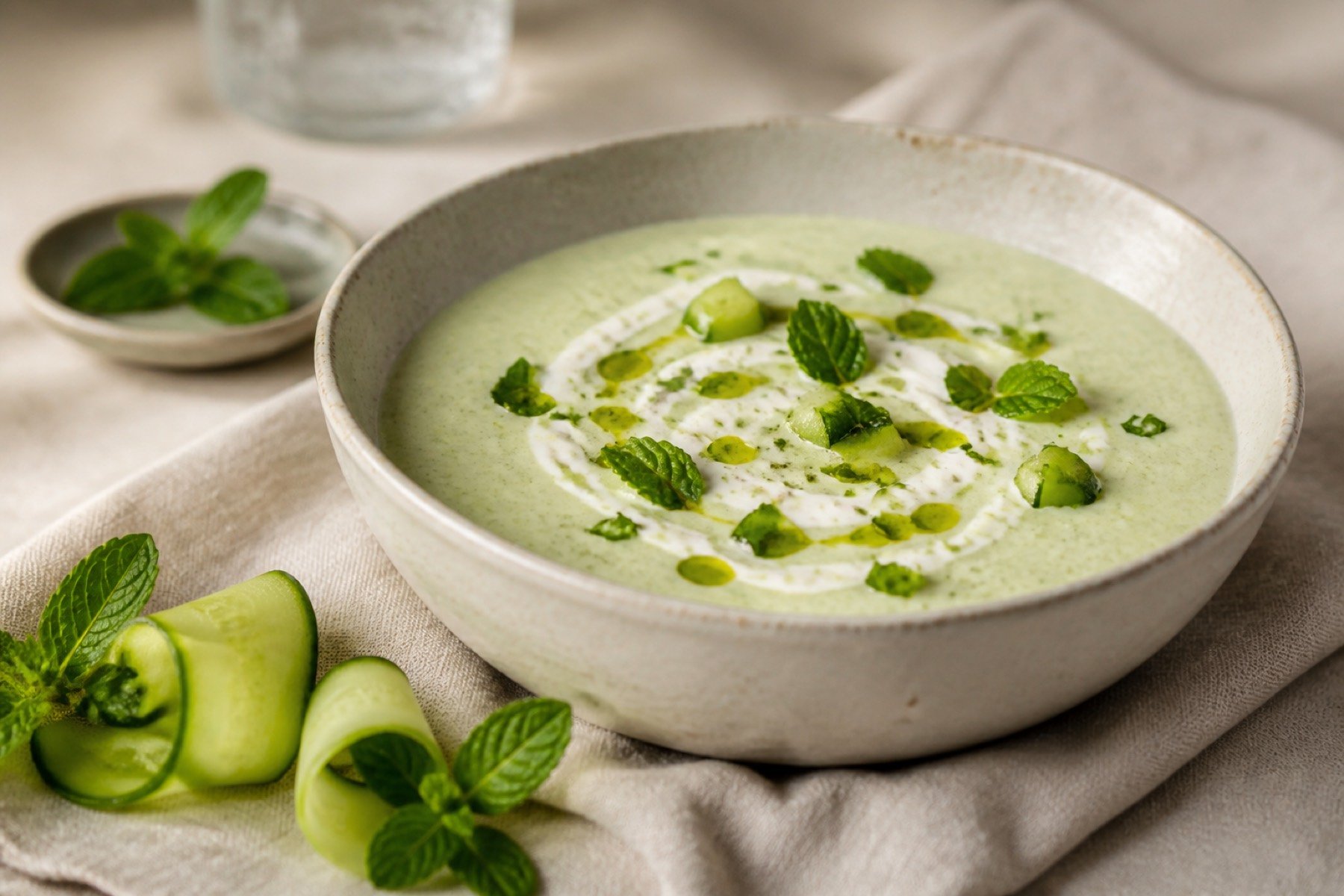
While the diary runs, eat food that works with a narrowed thermoneutral zone rather than against it: a proper Andalusian gazpacho, a chilled cucumber and yogurt soup, or an iced hibiscus tea in place of the fourth cuppa. The whole collection of cool and calm recipes is built to run cooler, and the trigger evidence, caveats included, is laid out on our cool and calm science page.