Few foods carry as much baggage as soy. Ask a room of British women in their forties about tofu and you'll hear everything from "isn't it oestrogenic?" to "I read it's risky after breast cancer" to a simple, weary "I wouldn't know what to do with it." All three deserve a proper answer, because the research record on soy is unusually long, unusually large, and considerably more reassuring than its reputation.
How soy got its bad name
The scare has traceable origins. In the 1990s and 2000s, studies in rodents showed that soy isoflavones could stimulate the growth of oestrogen-sensitive breast tumour cells. Alarming, until you look at the details. Rodents metabolise isoflavones very differently from humans, and many of those experiments used isolated compounds at doses far beyond anything achievable from eating actual food. Headlines carried the fear; the follow-up human research, which took years to accumulate, never carried the correction as loudly. That asymmetry is essentially the whole story of soy's reputation.
What isoflavones actually are
Soy's active compounds are isoflavones (mainly genistein and daidzein), a family of plant chemicals often called phytoestrogens. The name suggests they behave like oestrogen; the reality is subtler. Isoflavones bind to oestrogen receptors, but weakly (hundreds to thousands of times more weakly than your own oestradiol), and selectively. The body has two main oestrogen receptor types, and isoflavones show a clear preference for the beta receptor, which is more about bone, blood vessels and brain than breast tissue. Pharmacologists would describe them as something closer to a gentle, selective modulator than a hormone. That distinction, invisible in a headline, is why "plant oestrogen" turned out to be much less dramatic than it sounded.
"Isoflavones aren't oestrogen in a bean. They're weak, selective compounds, and forty years of human data show it."
Hot flushes: modest but real
The best-studied question is whether soy helps vasomotor symptoms. Multiple meta-analyses of randomised trials, including a frequently cited pooled analysis of around 20 trials, suggest soy isoflavones reduce hot flush frequency by roughly 20% and severity by a similar margin, over and above placebo. Trials typically used 50 to 100mg of isoflavones daily for at least 12 weeks, and the effect builds slowly; this is a habit, not a rescue remedy. To be clear about scale: HRT is considerably more effective, and NHS guidance rightly positions it as the first-line treatment for troublesome flushes. But for women who can't take HRT, are waiting to start, or simply want food on their side, the trial evidence says soy is one of the few dietary interventions with a genuine signal.
One honest wrinkle: the benefit may depend partly on your gut. Roughly a third of people (more in East Asian populations) carry gut bacteria that convert daidzein into a compound called equol, which appears more potent. This may explain why some women notice a clear difference and others little. You can't test for it at home; you can only try consistent intake for a couple of months and see.
The breast cancer question, answered calmly
This is the one that stops most women, so let's take it slowly. The fear came from rodents; the human evidence points the other way. Large observational studies following tens of thousands of women, including breast cancer survivors in both Asia and North America, have found that eating soy foods is associated with no increase in recurrence or mortality, and in several analyses with a modest reduction. The direction of the human evidence is consistent enough that major cancer bodies, including the World Cancer Research Fund and the American Cancer Society, state that soy foods are safe for survivors and may be beneficial.
The usual caveats apply and we'll make them plainly: this is observational data, which shows association rather than proof, and it concerns soy eaten as food, not high-dose isoflavone supplements, where the evidence is thinner and caution is reasonable. If you're in active treatment, your oncology team's advice comes first. But "tofu is risky after breast cancer" is not what forty years of human research says.
Two practical caveats worth knowing
- Thyroid medication timing. Soy doesn't damage a healthy thyroid at normal food intakes, but it can reduce the absorption of levothyroxine if eaten at the same time. If you take thyroid medication, the standard advice is to leave around four hours between your tablet and soy foods, and to keep your intake consistent so your dose is titrated to your real life.
- Fermented versus unfermented. Tempeh, miso and other fermented soys have had some of their compounds pre-digested by microbes, which may make isoflavones somewhat easier to absorb, and brings fermented-food benefits along for the ride. It's a nice bonus, not a requirement; the big survivor studies were built substantially on plain tofu and soy milk.
What a realistic UK portion looks like
The trial doses translate to one to two servings of soy food a day, which is smaller than it sounds:
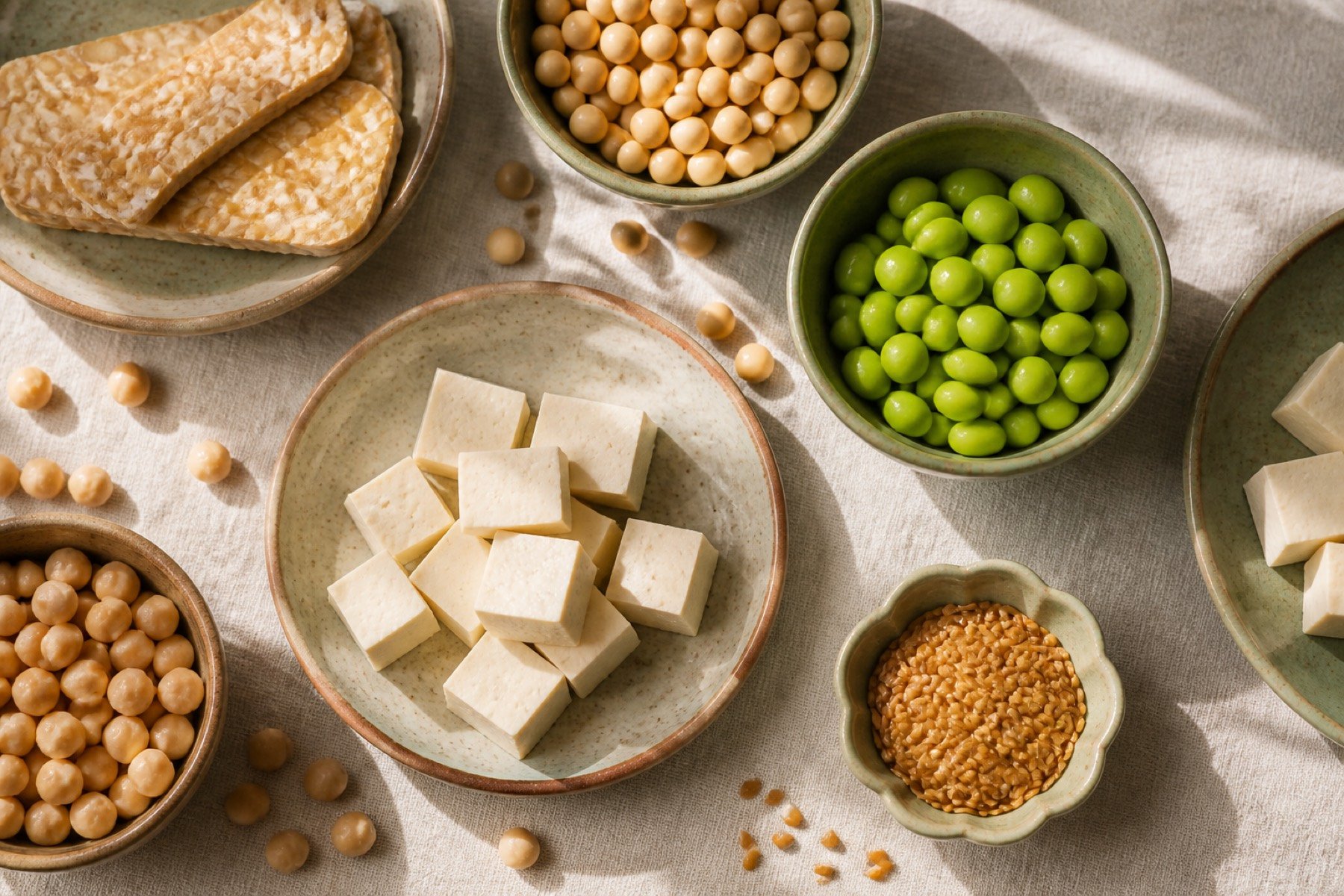
- Tofu (100g, about a quarter of a block): roughly 25mg of isoflavones. Firm tofu crisps beautifully; silken tofu disappears into soups and scrambles.
- Edamame (80g, a cereal-bowl handful, frozen is fine): around 20mg, plus protein and fibre.
- Tempeh (100g): about 30mg, with a nutty, mushroomy depth that wins over tofu sceptics.
- Miso (a tablespoon in soup or a marinade): a few milligrams, more seasoning than dose, but it all counts.
- Soy milk (250ml on porridge or in tea): about 25mg. The easiest swap of all.
Notice what's not on the list: powders, pills and 200mg mega-doses. The evidence is for food, eaten regularly, at portions a normal British kitchen can manage.
Something to actually cook
If tofu still feels foreign, start where it's familiar: a turmeric tofu scramble on sourdough reads like brunch, not health food, and smashed edamame and avocado toast is a five-minute lunch. For dinner, try the tempeh satay traybake or soy-glazed salmon with edamame smash. The full collection lives in our hormone-support recipes, and every claim in this article is referenced in plain English on our hormone science page.